What PCOS, PMDD, and Perimenopause Have in Common
What PCOS, PMDD, and Perimenopause Have in Common
If you have been diagnosed with any one of these, you probably have a specialist for it. A gynecologist managing your PCOS. A psychiatrist or therapist addressing the mood disruption of PMDD. A primary care doctor telling you perimenopause is "just part of aging." Three separate appointments, three separate conversations, three separate treatment plans that never talk to each other. But what if they are not three separate problems?
The pattern nobody connects
PCOS, PMDD, and perimenopause look different on the surface — different symptoms, different ages of onset, different specialists. Underneath, they share a remarkably similar set of drivers.
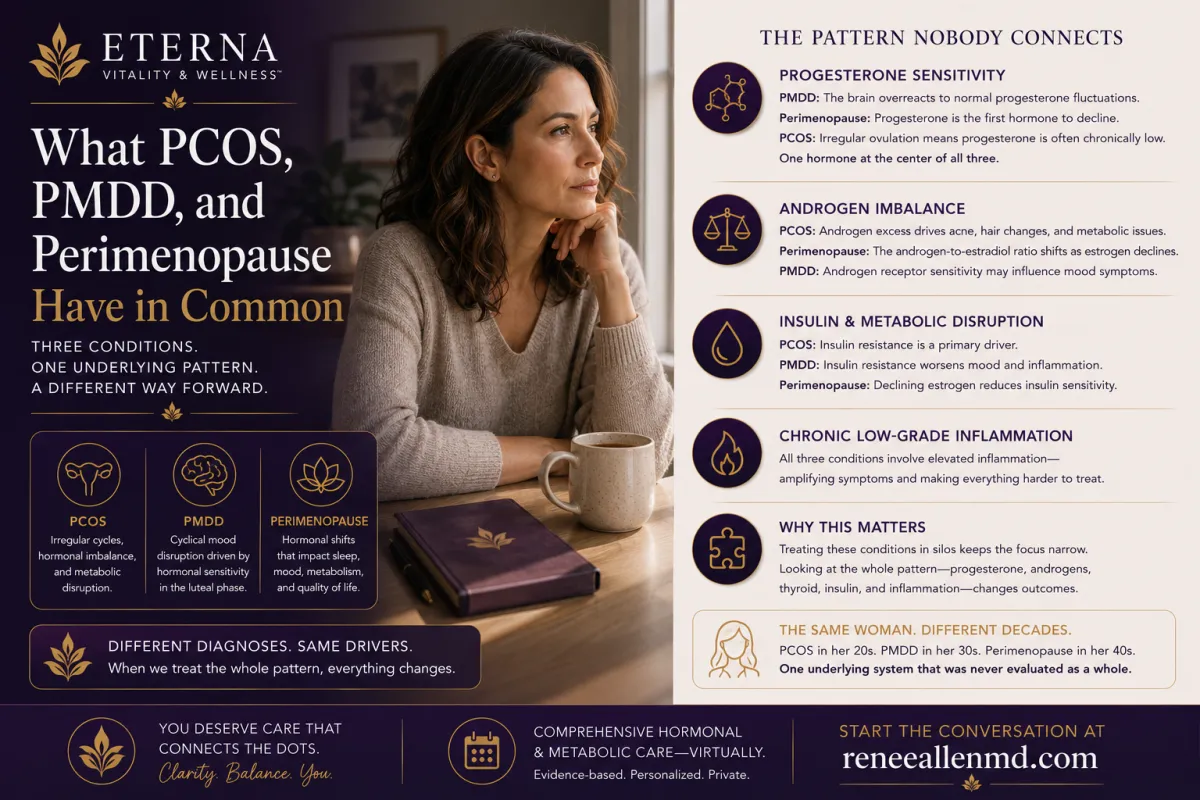
Progesterone sensitivity. In PMDD, the brain responds abnormally to normal progesterone fluctuations, creating mood disruption and cognitive shutdown in the luteal phase. In perimenopause, progesterone is the first hormone to decline, driving cycle irregularity, sleep disruption, and anxiety long before estradiol visibly drops. In PCOS, progesterone is often chronically low because irregular ovulation means the signal to produce it never fires consistently. Three conditions, one hormone at the center of all of them.
Androgen imbalance. PCOS is defined in part by androgen excess — acne, hair changes, metabolic disruption. But androgen shifts do not stop there. In perimenopause, the ratio of androgens to estradiol changes as estradiol declines, producing new acne, thinning hair, and shifts in body composition women rarely connect to the transition. And in PMDD, emerging research suggests androgen receptor sensitivity may influence how the brain processes luteal-phase hormonal shifts.
Insulin and metabolic disruption. Insulin resistance is the metabolic engine behind most PCOS cases. It also worsens PMDD by amplifying inflammatory signaling, and in perimenopause, declining estradiol reduces insulin sensitivity — so women who never had blood sugar issues suddenly find themselves gaining weight, crashing mid-afternoon, and craving carbohydrates in a pattern that mirrors PCOS.
Chronic low-grade inflammation. All three involve elevated inflammatory markers, and in each, inflammation amplifies every other symptom in the system.
Why this matters for treatment
When these conditions are treated in silos, the interventions stay narrow. PCOS gets birth control and metformin. PMDD gets an antidepressant. Perimenopause gets a suggestion to wait it out or a single prescription without context. Each may help one layer of one condition. None addresses the shared pattern running underneath all three.
When you zoom out, the approach shifts. Progesterone is not just a reproductive hormone — it is a neurological stabilizer, a sleep regulator, and a metabolic player, and evaluating it across all three conditions changes outcomes isolated treatment misses. Insulin management is not just for PCOS; addressing it early in perimenopause improves weight, energy, mood, and inflammation that hormone therapy alone does not fully resolve. Androgen balance requires the full hormonal picture, not suppression in isolation. And inflammation is the amplifier — reduce it, and every other intervention works against a quieter baseline.
The same woman, different decades
In her 20s she was diagnosed with PCOS and put on birth control. In her 30s, the cyclical mood crashes arrived and earned a PMDD label and an antidepressant. In her 40s, the sleep, the weight, and the brain fog were waved off as perimenopause. Three decades, three labels, one underlying system that was never evaluated as a whole.
That is the work I do.
At Eterna Vitality & Wellness, we evaluate the complete hormonal and metabolic picture together — progesterone, androgens, thyroid, and insulin — in a private virtual consultation, and build a plan around the pattern, not a single symptom.
If your care has been split across three doctors who never compared notes, start the conversation at reneeallenmd.com.


