Progesterone and Sleep: The Connection Your Doctor May Not Have Mentioned
Progesterone and Sleep: The Connection Your Doctor May Not Have Mentioned
If you've been struggling with sleep since your early forties — waking at 3am with a mind that won't quit, lying in bed staring at the ceiling, dragging yourself through days that used to feel effortless — you may have already tried everything on the standard list. Melatonin. Sleep hygiene. Screen-free evenings. Maybe even a prescription.
And still, the sleep isn't there.
Here's what I want to tell you as a board-certified OBGYN and integrative hormone specialist: your sleeplessness may not be about your habits at all. It may be about your hormones.
What Progesterone Does in the Brain
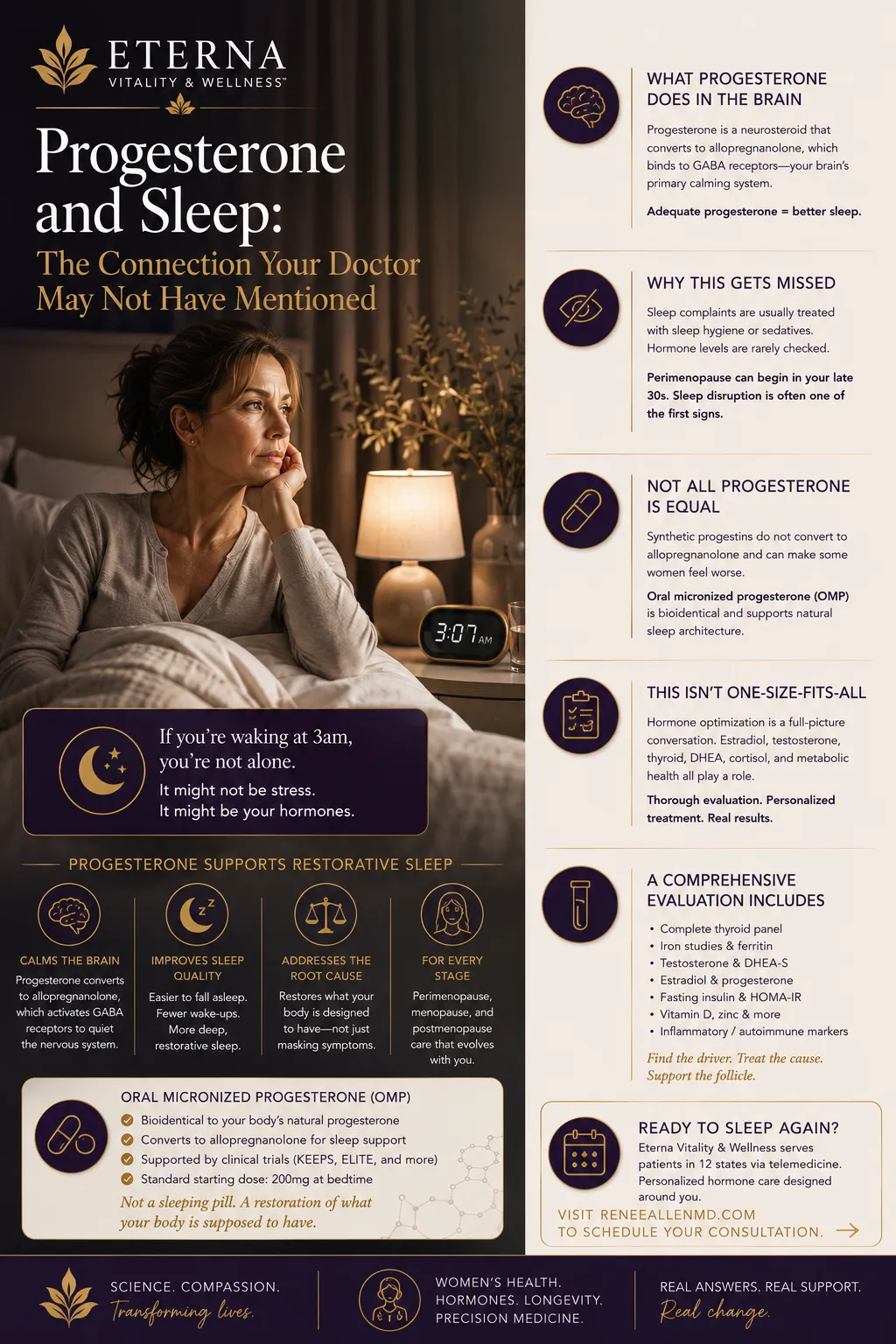
Progesterone is a hormone most people associate with pregnancy. But progesterone is also a neurosteroid. In the brain, it converts to a metabolite called allopregnanolone, which binds to GABA receptors — your brain's primary calming neurotransmitter system, the same receptor system targeted by benzodiazepines. In other words, progesterone has a natural, gentle, sedative-like effect on the nervous system.
When progesterone levels are adequate, many women report falling asleep more easily, staying asleep longer, and experiencing more restorative deep sleep. When progesterone drops — which happens during perimenopause, often years before the final menstrual period — that natural calming effect disappears.
And that's when 3am becomes a very familiar hour.
Why This Gets Missed
The standard approach to sleep complaints is not to check hormone levels. It's to recommend sleep hygiene, then escalate to sedatives if that doesn't work. That pathway is not wrong — but it misses something critical for a significant number of perimenopausal and menopausal women.
Perimenopause can begin as early as the late thirties. Sleep disruption is frequently one of its earliest symptoms — often appearing before hot flashes, before mood changes, sometimes before any irregularity in the menstrual cycle. Most women are not told this. Most physicians were not trained on this. And so a woman who is hormonally disrupted gets handed a sleep medication instead of a hormone evaluation.
This is exactly the kind of gap I built Eterna Vitality & Wellness to address.
Oral Micronized Progesterone: What the Evidence Shows
Not all progesterone is created equal. Synthetic progestins — like medroxyprogesterone acetate, found in some older hormone formulations — do not convert to allopregnanolone in the same way and do not carry the same sleep-promoting effects. In fact, some women feel worse on synthetic progestins.
Oral micronized progesterone (OMP) is bioidentical — structurally identical to the progesterone your body produces. When taken orally at night, it undergoes first-pass metabolism and produces higher levels of allopregnanolone, which directly supports sleep architecture. Multiple clinical studies, including data from the KEEPS and ELITE trials, support its use in perimenopausal and menopausal women. When dosed appropriately — I often start standardly at 200mg at bedtime for women with significant sleep disruption — the improvement in sleep quality can be dramatic.
Not a sleeping pill. A restoration of what your body is supposed to have.
This Is Not a One-Size-Fits-All Conversation
Hormone optimization is never a checklist. Every woman presents differently — her symptoms, her hormone levels, her medical history, her goals, and her values all shape the clinical picture. Progesterone is one piece of a larger hormonal picture that may also include estradiol, testosterone, thyroid function, DHEA, cortisol, and metabolic health markers.
That's why thorough evaluation matters. That's why I take the time I do with every patient at Eterna Vitality & Wellness. Because the right answer isn't just a prescription — it's a precise understanding of what your body needs and why.
If you've been told your sleeplessness is just stress, or age, or something you need to accept — I'd like to offer you a different perspective. Sleep disruption is data. It's your body communicating something. And you deserve a physician who knows how to listen.
Ready to Have a Different Conversation About Your Health?
Eterna Vitality & Wellness serves patients across 12 states via telemedicine. Whether you're in perimenopause, menopause, or postmenopause, we offer personalized hormone evaluation and optimization care designed around you — not a protocol.
Visit reneeallenmd.com to learn more and schedule a consultation.


