Why Your Hair Is Thinning — And Why the Answer Isn't the Same for Every Woman
Why Your Hair Is Thinning — And Why the Answer Isn't the Same for Every Woman
More hair in the drain. A ponytail that feels thinner. A part that looks wider than it used to.
You mentioned it to your doctor. They said stress. Maybe aging. Maybe try biotin.
And that's where the conversation ended. Not because the answer doesn't exist, but because nobody looked for it.
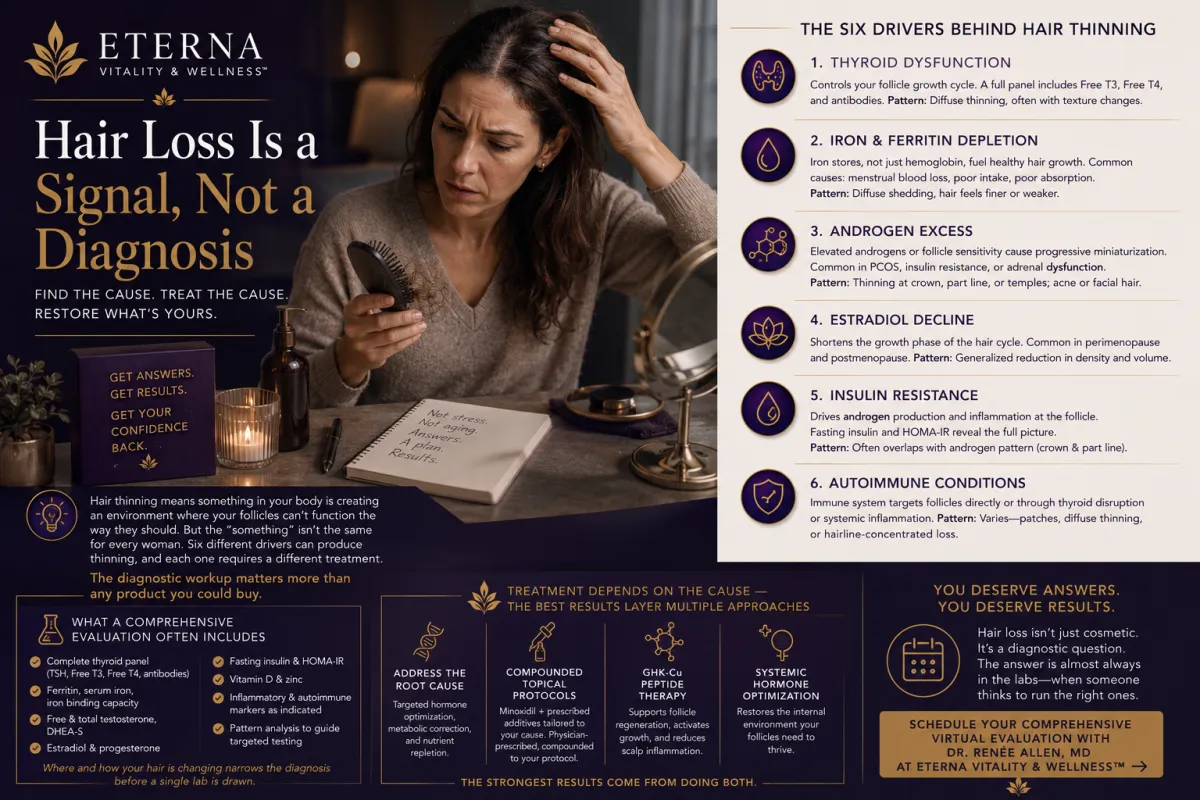
Hair Loss Is a Signal, Not a Diagnosis
Hair thinning means something in your body is creating an environment where your follicles can't function the way they should. But the "something" isn't the same for every woman. Six different drivers can produce thinning, and each one requires a different treatment.
The diagnostic workup matters more than any product you could buy.
The Six Drivers
1. Thyroid Dysfunction
Your thyroid controls the growth cycle of every follicle on your head. When function slows, even subtly, hair responds before almost anything else. Texture changes first (drier, coarser, more brittle), then growth slows, then shedding increases.
A standard screening only checks TSH. A complete panel includes Free T3 (the active hormone your follicles actually use), Free T4, and thyroid antibodies to screen for autoimmune thyroid disease.
Pattern: Diffuse thinning across the entire scalp, often with texture changes months before visible shedding.
2. Iron and Ferritin Depletion
Hemoglobin tells you whether you're anemic. Ferritin tells you whether your iron stores are adequate for hair growth. Many women have a normal hemoglobin and a ferritin too low to sustain healthy follicle function. Common causes: menstrual blood loss, inadequate dietary intake, poor absorption.
Pattern: Diffuse shedding. Hair may feel finer or weaker overall.
3. Androgen Excess
When androgens like testosterone and its derivative DHT rise above a healthy range, or when follicles are genetically sensitive to normal levels, the follicle gradually shrinks. Each cycle produces a thinner, weaker strand until growth stops. This is the driver behind most PCOS-related hair changes, but it can also stem from insulin resistance or adrenal dysfunction.
Pattern: Thinning at the crown, along the part line, or at the temples. Often accompanied by jawline acne or increased facial hair.
4. Estradiol Decline
Estradiol extends the active growth phase of the hair cycle. As it declines during perimenopause or postmenopause, the growth phase shortens, strands thin, and overall density gradually reduces. No dramatic shedding event. Just a slow loss of fullness.
Pattern: Generalized reduction in density and volume across the scalp.
5. Insulin Resistance
Excess insulin stimulates the ovaries and adrenal glands to produce more androgens and increases inflammation at the follicle level. Standard blood sugar tests often look normal while insulin is already elevated. Fasting insulin and HOMA-IR reveal the full picture.
Pattern: Often overlaps with the androgen pattern (crown and part line) because the two are mechanistically linked.
6. Autoimmune Conditions
The immune system can target the hair follicle directly (alopecia areata) or affect hair through thyroid disruption (Hashimoto's) or systemic inflammation (lupus). Autoimmune markers help identify whether the immune system is part of the picture.
Pattern: Varies. Distinct patches (alopecia areata), diffuse thinning (thyroiditis), or hairline-concentrated loss (lupus).
Why the Pattern Matters
Where and how your hair is changing narrows the diagnosis before a single lab is drawn. Diffuse thinning points toward thyroid, iron, or estradiol. Crown and part line thinning suggests androgens or insulin. Distinct patches suggest autoimmune involvement. Your physician uses the pattern to make the lab workup targeted, not generic.
What a Comprehensive Evaluation Often Includes
→ Complete thyroid panel (TSH, Free T3, Free T4, antibodies)
→ Ferritin, serum iron, and iron binding capacity
→ Free and total testosterone, DHEA-S
→ Estradiol and progesterone
→ Fasting insulin and HOMA-IR
→ Vitamin D and zinc
→ Inflammatory and autoimmune markers as indicated
Treatment Depends on the Cause — And the Best Results Layer Multiple Approaches
Once the labs identify what's driving the thinning, treatment becomes specific. But for most women, the strongest results come from addressing the internal cause and supporting the follicle directly at the same time.
Addressing the Root Cause
The labs tell you what's driving the thinning. Treatment starts there.
If it's thyroid, we optimize hormone levels so the follicle gets the growth signal it needs. If it's iron, we replete stores to a level that actually supports hair, not just prevents anemia. If androgens are elevated, we identify whether the source is ovarian, adrenal, or insulin-driven, and address it at the origin. If estradiol has declined, hormone optimization restores the growth phase signaling the follicle depends on. If insulin resistance is fueling the pattern, metabolic correction reduces the androgen stimulation and inflammation happening at the follicle level.
The specifics vary. The principle doesn't: identify the driver, treat the driver, and the follicle's environment improves from the inside out.
But internal correction takes time to reach the hair. That's where targeted follicle-level therapies come in — supporting the scalp directly while the body recalibrates underneath.
Compounded Topical Protocols
Minoxidil remains one of the most evidence-supported topical treatments for hair thinning, working by increasing blood flow to the follicle and extending the growth phase. At Eterna Vitality & Wellness™, we prescribe compounded formulations tailored to the specific driver behind your loss — combinations of minoxidil with finasteride, spironolactone, or biotin in a base optimized for scalp penetration. These formulations are prescribed by Dr. Renée Allen, compounded to your protocol, and shipped directly to your door. They represent a meaningful step beyond anything available over the counter, and they work best when paired with the internal optimization happening simultaneously.
GHK-Cu Peptide Therapy
GHK-Cu (copper peptide) is a naturally occurring tripeptide with well-documented effects on hair follicle biology. It promotes follicle proliferation, activates resting-phase follicles back into active growth, and reduces scalp inflammation — through mechanisms entirely distinct from minoxidil. We incorporate GHK-Cu into topical scalp protocols as a regenerative layer alongside standard topical therapy. Applied consistently, it creates a more favorable biological environment for the follicle — something systemic treatment alone doesn't always fully address.
Systemic Hormone Optimization
When estradiol decline is shortening the growth phase, restoring estradiol to optimal physiologic levels directly supports follicle function — not as a cosmetic treatment, but as a hormonal correction with measurable effects on the hair cycle. Similarly, normalizing androgens, thyroid function, and insulin resistance through comprehensive hormone optimization creates the biological environment that topical therapies need in order to work. One without the other produces partial results at best.
Targeted Nutritional Repletion
Labs-guided supplementation — not generic biotin — closes the specific gaps limiting your hair's recovery. Iron repletion to a ferritin that genuinely supports follicle activity (not just clears the anemia threshold), vitamin D optimization, and zinc support each contribute to the internal environment topical treatments can't fully compensate for. The goal is precision: addressing what your specific labs show is missing, in the amounts that actually move the markers.
The Layered Approach
The women who see the strongest hair restoration outcomes aren't choosing between internal treatment and scalp-level therapy. They're doing both.
A typical Eterna hair restoration protocol might look like:
→ Months 1–2: Comprehensive lab workup, root cause identification, internal treatment initiated (hormone optimization, metabolic correction, nutrient repletion)
→ Months 1–3: Compounded topical protocol started (minoxidil + compounded additives tailored to cause), GHK-Cu peptide added as a regenerative layer
→ Months 3–6: Internal markers retested and adjusted, visible reduction in shedding and new growth beginning
→ Ongoing: Continued internal optimization and topical support, protocol refined based on your response
Hair restoration through virtual, physician-led care is not a single conversation. It's a treatment plan built in layers, timed to how the follicle actually heals and grows — and it starts with finding the answer that's been missing.
If This Sounds Like You
If the only answer you've received is stress, aging, or a supplement suggestion, that's not a dead end. It's a missed step. The labs that identify the cause are straightforward. The treatment, once the driver is known, is specific. And the earlier you start, the more the follicle has to work with.
At Eterna Vitality & Wellness™, we approach hair loss as a diagnostic question, not a cosmetic one.
The answer is almost always in the labs — when someone thinks to run the right ones.


