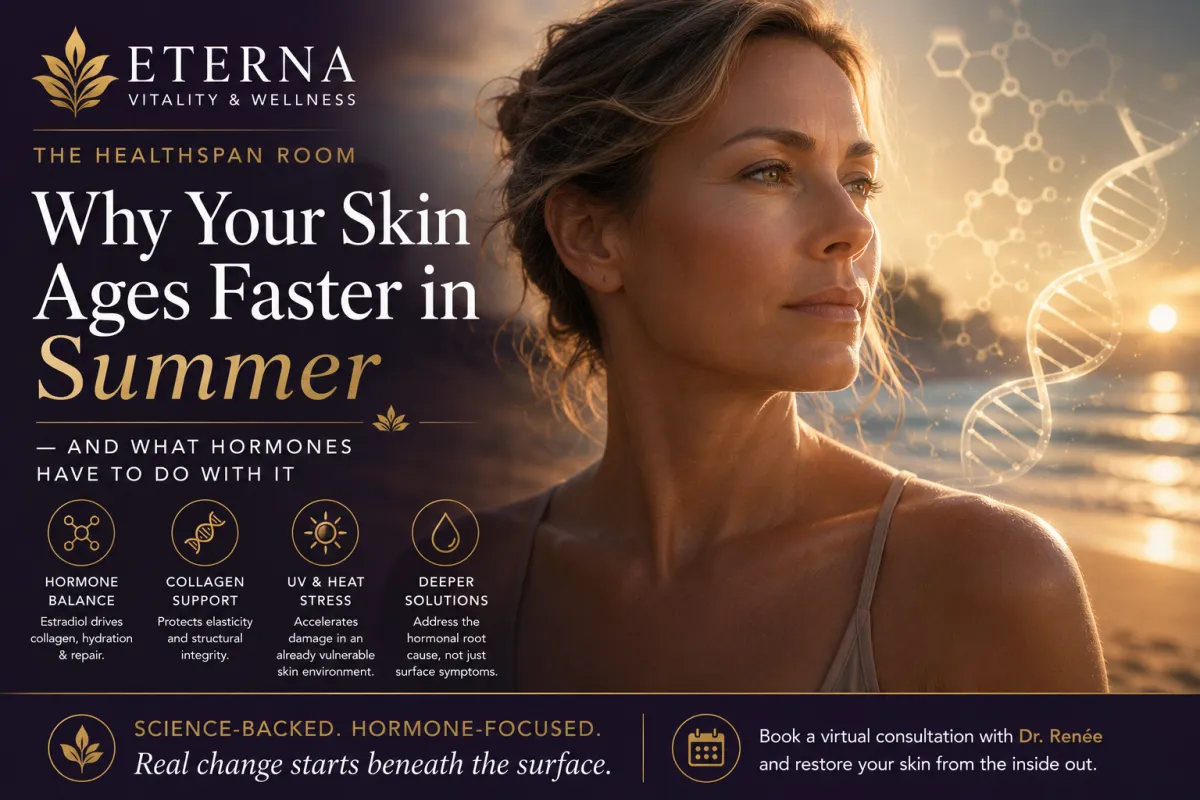
Why Your Skin Ages Faster in Summer — And What Hormones Have to Do With It
Summer and Skin: What the Sunscreen Doesn't Tell You
You wear sunscreen. You stay hydrated. You avoid the peak afternoon sun. And still, you look at your skin mid-July and notice something that was not there in April — a deepening of lines around the eyes, a loss of elasticity in the lower face, a texture change that sunscreen cannot explain.
What is happening is not primarily a UV story. It is a hormonal one.
At Eterna Vitality & Wellness, I approach skin aging the same way I approach every other symptom my patients bring to me: by looking for the internal driver first. And in summer, that driver is almost always the compounding effect of heat, UV, and hormonal decline — three forces that accelerate collagen breakdown simultaneously.
Estradiol Is Your Skin's Most Important Structural Hormone
Most people know estradiol as a reproductive hormone. But estradiol is also one of the most important regulators of skin structure and function in the human body. It drives fibroblast activity — the cellular process by which collagen and elastin are produced and maintained. It regulates skin hydration by influencing hyaluronic acid production in the dermis. It supports wound healing and tissue repair at a cellular level.
Estradiol is responsible for up to 30% of skin collagen production. This is not a cosmetic statistic — it is a structural one. As estradiol declines in perimenopause and menopause, the skin's ability to produce, maintain, and repair collagen is directly compromised. The result is not just surface dryness. It is a loss of structural density that changes how the face holds light, how expression lines resolve, and how quickly UV damage accumulates.
What Summer Does to an Already-Compromised Skin Environment
For women with declining estradiol, summer introduces two additional stressors that accelerate the damage that is already occurring.
The first is UV radiation. UV breaks down collagen directly through photooxidative damage, and it does so faster and more irreversibly in skin that is already losing its structural support. A woman with optimal estradiol levels and robust collagen production has more reserve to absorb and repair UV damage. A woman whose collagen production is already compromised by hormonal decline has far less margin before the damage becomes permanent.
The second is heat-driven dehydration. Heat accelerates transepidermal water loss — the passive evaporation of moisture through the skin barrier. When the skin barrier is already compromised by declining estradiol and collagen, this dehydration accelerates the formation of fine lines, impairs the skin's ability to reflect light evenly, and reduces the plumpness that characterizes youthful skin architecture.
Together, these two factors do not simply add to existing hormonal skin aging. They compound it — creating damage in a matter of weeks that can take months to address.
Why Topical Products Cannot Solve a Hormonal Problem
The skincare industry is well-designed to address surface-level symptoms. Retinoids stimulate collagen production at the skin surface. Hyaluronic acid draws moisture into the dermis. Peptides signal fibroblast activity. All of these can be helpful — but they are working against a deficit that begins far below the surface.
Topical products cannot restore the estradiol-driven collagen synthesis that has been lost. They cannot reverse the structural changes in the dermis that occur when fibroblast activity declines over years. And they cannot protect the skin's future capacity to repair UV damage when the hormonal foundation of that repair process is compromised.
This is why patients at Eterna Vitality & Wellness who are on optimized estradiol protocols consistently report changes in skin quality that feel different from what any topical product produced. Skin that holds moisture differently. Lines that are less pronounced because the underlying collagen is being supported. Texture changes that reflect restored cellular function, not just surface-level hydration.
Building a Skin-Protective Protocol That Actually Works
At Eterna Vitality & Wellness, skin health is not a cosmetic consultation. It is a clinical discussion about the hormonal environment that determines how your skin ages — and how we can intervene at the structural level.
For patients who are interested in addressing skin aging as part of their hormone optimization, we evaluate estradiol levels in the context of skin-specific symptoms, assess whether peptide therapy for collagen support is appropriate, and develop a strategy that addresses the internal driver rather than layering topical products on top of an unresolved hormonal deficit.
If your skin has been changing in ways you cannot explain with sunscreen and products, the conversation worth having is a hormonal one.
Book a Ground Zero: First Step Consultation virtual consultation with Dr. Renée at Eterna Vitality & Wellness and find out what restoring your skin's hormonal foundation actually looks like.


