Why Most Physicians Aren't Trained in Hormone Therapy — And What That Means for You
Why Most Physicians Aren't Trained in Hormone Therapy — And What That Means for You
If you've spent years feeling dismissed by your doctor about your hormonal symptoms, this post is for you. Not to assign blame — but to explain something most patients don't know, and most physicians won't say out loud.
The vast majority of physicians practicing in the United States today received little to no formal training in bioidentical hormone restoration therapy. That's not a fringe claim. It's a structural fact about how we train doctors.
What Medical School Teaches (and Doesn't)
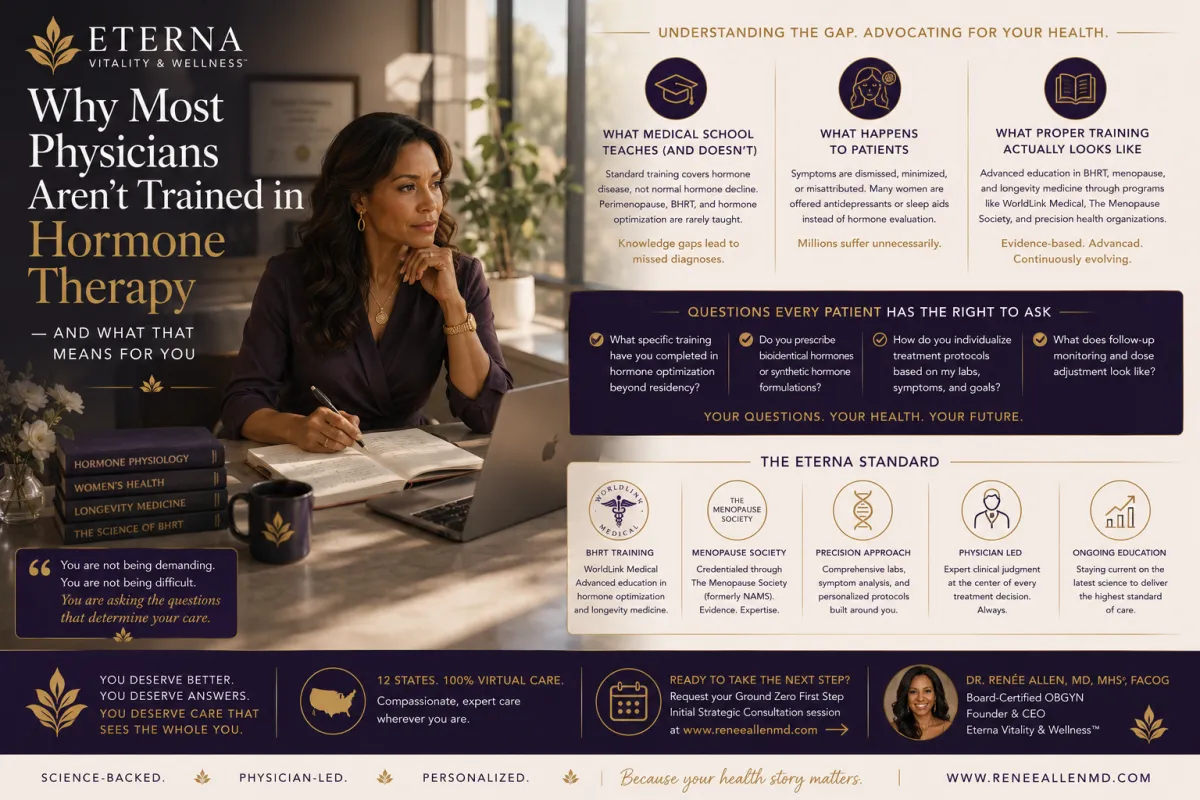
Standard medical education covers hormones in the context of pathology — thyroid disease, adrenal disorders, reproductive endocrinology for conditions like PCOS or premature ovarian failure. What it does not cover, in any meaningful depth, is the physiology of hormone decline in otherwise healthy women moving through the natural stages of perimenopause and menopause.
The data on estradiol, progesterone, testosterone, and their roles in metabolic health, cognition, cardiovascular protection, bone density, and sexual wellness is abundant and expanding. But it doesn't get taught in standard residency training. Physicians graduate with a framework that positions hormone therapy as primarily a symptom management tool — and a risky one at that, shaped heavily by 2002 Women's Health Initiative findings that have since been substantially reinterpreted and challenged.
The result is a generation of well-trained physicians who genuinely don't have the tools to evaluate or treat hormonal imbalance comprehensively. They aren't withholding care maliciously. They simply weren't trained.
What Happens to Patients as a Result
Women between the ages of 35 and 55 — trying to manage perimenopause — are among the most underserved patients in medicine. They arrive at their physician's office with a constellation of symptoms: fatigue that eight hours of sleep doesn't fix, cognitive fog that disrupts their work, weight gain that doesn't respond to diet and exercise, disrupted sleep, low libido, mood dysregulation. Classic perimenopause.
What happens next is often a referral, a sleep aid prescription, or — disturbingly commonly — an antidepressant, offered as a treatment for what is, at its core, a hormone insufficiency.
This pattern is not rare. It is the norm.
I know because I experienced it personally. As a board-certified OBGYN with over two decades of clinical experience and professional relationships across major health systems, I still could not find a physician who understood my perimenopausal symptoms. I was told it was aging. I was offered antidepressants.
That experience changed everything about how I practice medicine.
What Proper Training Actually Looks Like
Physician training in bioidentical hormone restoration therapy happens outside of standard medical education — through specialized programs like WorldLink Medical, advanced credentialing through The Menopause Society (formerly NAMS), and clinical education through the Obesity Medicine Association and precision longevity medicine organizations.
This training covers the evidence base for bioidentical estradiol and progesterone (as distinguished from synthetic hormone formulations), testosterone optimization in both women and men, the relationship between hormonal balance and metabolic health, and the clinical nuance of individualizing protocols based on patient history, labs, symptoms, and goals.
It is rigorous. It requires ongoing education as the science evolves. And it is not something most practicing physicians have completed.
What You Can Do with This Information
The point of this post isn't to make you distrust your physician. It's to give you language and context for advocating for yourself.
If you are experiencing symptoms consistent with perimenopause or hormonal imbalance, it is completely appropriate to ask:
What specific training have you completed in hormone optimization beyond residency?
Do you prescribe bioidentical estradiol and progesterone, or do you prefer synthetic hormone formulations?
How do you individualize treatment protocols, and what does follow-up monitoring look like?
The answers tell you a great deal about the quality of care you'll receive.
You are not being demanding. You are not being difficult. You are asking the questions that determine whether the physician in front of you is positioned to actually help you.
The Standard We Hold at Eterna Vitality & Wellness
At Eterna Vitality & Wellness, every aspect of our clinical approach to hormone care is grounded in advanced, specialized training. My BHRT training was completed through WorldLink Medical. I hold credentials through The Menopause Society and continuously update clinical protocols through my involvement with precision longevity and peptide therapy organizations including The American Peptide Society.
When you come to us, you receive care designed around your individual physiology, your symptoms, your labs, and your goals — not a protocol pulled from a general practice guideline that hasn't kept pace with the science.
You deserve that level of care. And you deserve to know how to find it.
If you're ready to explore what personalized hormone care looks like, we serve patients in 12 states through 100% virtual care.
Visit www.reneeallenmd.com to learn more or request your Ground Zero First Step Initial Strategic consultation session HERE.


