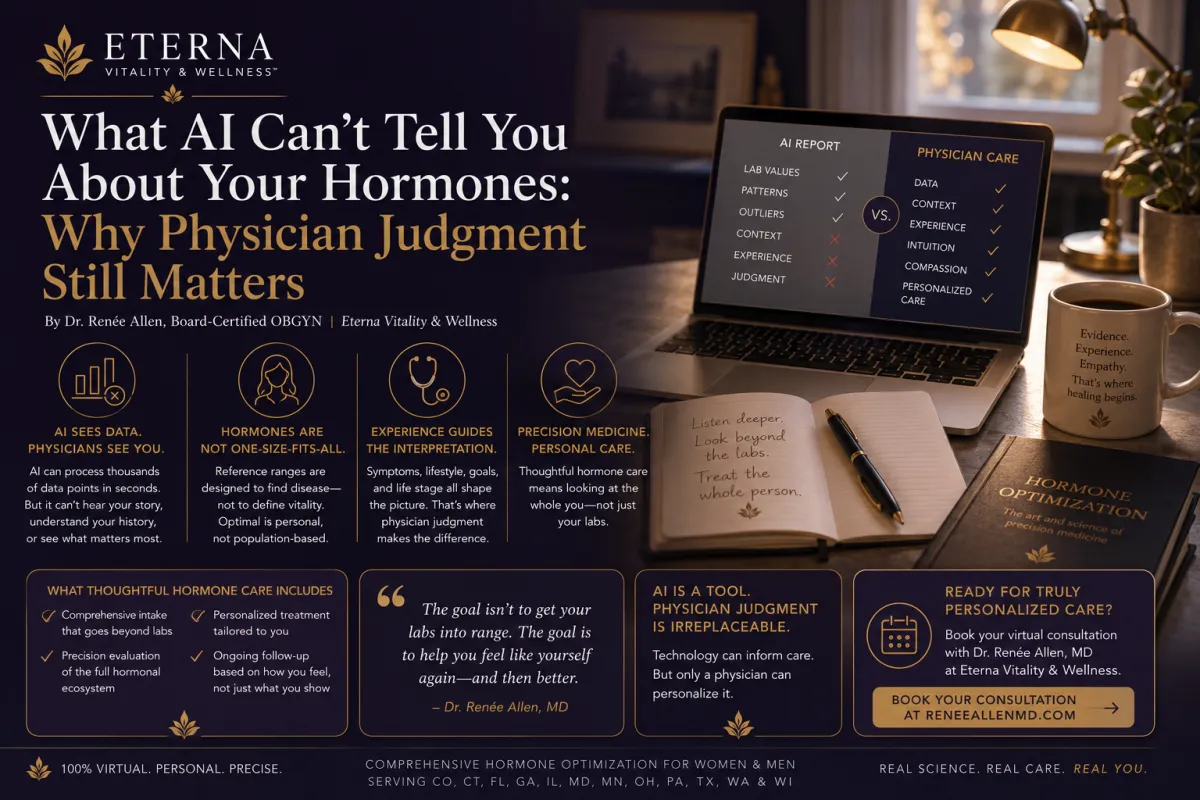
What AI Can't Tell You About Your Hormones: Why Physician Judgment Still Matters
What AI Can't Tell You About Your Hormones: Why Physician Judgment Still Matters
By Dr. Renée Allen, Board-Certified OBGYN | Eterna Vitality & Wellness
This past week, I spent time reviewing AI-generated patient reports from a clinical technology platform I'm consulting on. My role was to evaluate the clinical accuracy and relevance of what the AI was producing — to look at the reports the way a physician would before trusting them to guide real patient care.
And I want to share what I found, because I think it matters for you as a patient.
The AI Was Impressive. And It Was Also Wrong in Ways That Mattered.
The platform's AI could aggregate lab values, identify patterns, flag outliers, and generate reports faster than any human.
In some ways, it was extraordinary.
This is the promise of AI in medicine — and it's real.
But here's what it couldn't do:
It couldn't hear the patient describe two years of not sleeping through the night.
It couldn't make the connection between "normal" thyroid labs and a patient whose symptoms pointed unmistakably to dysfunction.
It couldn't factor in that a woman's estradiol levels might be technically within range but insufficient to prevent the bone density loss she was experiencing.
It saw numbers. It didn't see the person behind them.
Why This Matters Specifically for Hormone Health
Hormone optimization is an area where AI limitations are particularly significant — and where physician judgment is irreplaceable.
The reference ranges that most labs use for hormones like estradiol, progesterone, testosterone, DHEA, and cortisol were established to identify disease, not to define optimal health. A value that falls within "normal" range can still be profoundly suboptimal for a particular person at a particular stage of their life.
This is why I practice precision medicine, not protocol medicine.
When a woman comes to me in perimenopause describing sleep disruption, brain fog, anxiety, and joint pain — and her labs return "within normal limits" — the algorithmic response might be: no action needed.
My response is to look deeper.
To ask more questions.
To understand her history, her lifestyle, her goals, and her experience of her own body.
Because the data point isn't the patient. The patient is the patient.
What Thoughtful Hormone Care Actually Looks Like
At Eterna Vitality & Wellness, every patient receives a comprehensive intake that goes beyond labs. I want to know how you're sleeping, how your energy tracks across the day, and what your quality of life actually feels like.
These subjective realities are clinical data.
When I prescribe bioidentical hormone therapy, I'm not matching a number to a dose. I'm tailoring a protocol to a human being — with all the complexity, history, and individuality that entails. I use estradiol (not the less-precise term "estrogen") because precision in language reflects precision in practice. I look at the full hormonal ecosystem: progesterone, testosterone, DHEA, thyroid, cortisol, and more.
I also review how treatments are working — not just by repeating labs, but by asking:
How do you feel?
Has anything changed?
What's better, and what isn't?
This iterative, responsive approach is how hormone optimization actually works.
AI as a Tool, Not a Replacement
I am not anti-technology. I use advanced diagnostics. I consult on clinical AI platforms. I believe that well-designed technology has the potential to make medicine more accessible, more efficient, and more consistent.
But technology is a tool.
Its value depends entirely on whether the person in front of you is being seen as a whole human being, not just a data set.
If you are seeking care for perimenopause, hormone imbalance, or metabolic dysfunction — please find a physician who is willing to look at all of it.
A physician who asks questions that go beyond your labs.
A physician who sees you.
Ready to Experience Truly Personalized Hormone Care?
Eterna Vitality & Wellness is a 100% virtual telemedicine practice serving patients in Colorado, Connecticut, Florida, Georgia, Illinois, Maryland, Minnesota, Ohio, Pennsylvania, Texas, Washington, and Wisconsin.
I offer comprehensive hormone optimization for women and men — grounded in evidence-based medicine, delivered with the personal attention that makes real transformation possible.


