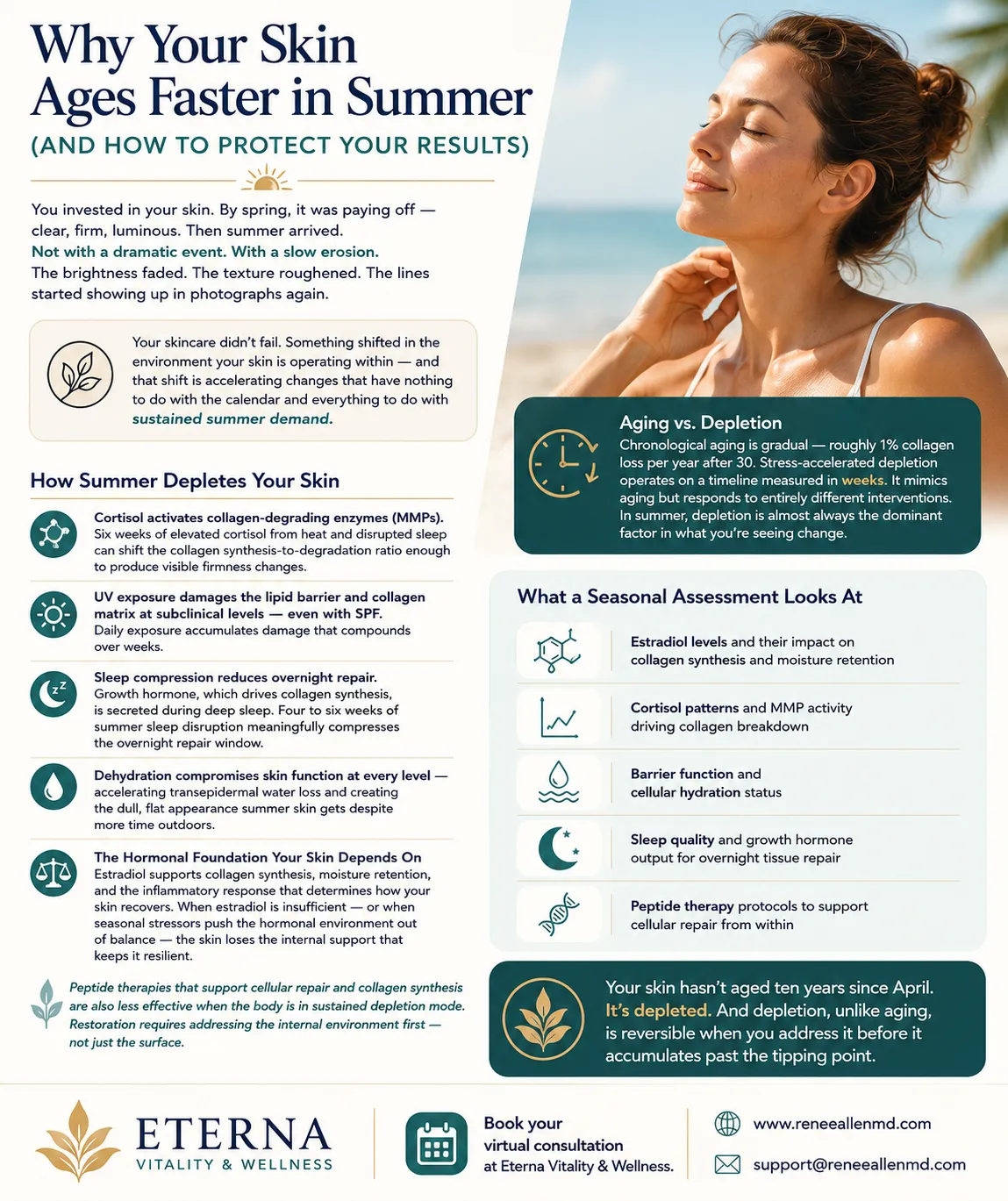
Why Your Skin Ages Faster in Summer (And How to Protect Your Results)
You invested in your skin. By spring, it was paying off — clear, firm, luminous. Then summer arrived. Not with a dramatic event. With a slow erosion. The brightness faded. The texture roughened. The lines started showing up in photographs again.
Your skincare didn't fail. Something shifted in the environment your skin is operating within — and that shift is accelerating changes that have nothing to do with the calendar and everything to do with sustained summer demand.
Aging vs. Depletion
Chronological aging is gradual — roughly 1% collagen loss per year after 30. Stress-accelerated depletion operates on a timeline measured in weeks. It mimics aging but responds to entirely different interventions. In summer, depletion is almost always the dominant factor in what you're seeing change.
How Summer Depletes Your Skin
Cortisol activates collagen-degrading enzymes (MMPs). Six weeks of elevated cortisol from heat and disrupted sleep can shift the collagen synthesis-to-degradation ratio enough to produce visible firmness changes.
UV exposure damages the lipid barrier and collagen matrix at subclinical levels — even with SPF. Daily exposure accumulates damage that compounds over weeks.
Sleep compression reduces overnight repair. Growth hormone, which drives collagen synthesis, is secreted during deep sleep. Four to six weeks of summer sleep disruption meaningfully compresses the overnight repair window.
Dehydration compromises skin function at every level — accelerating transepidermal water loss and creating the dull, flat appearance summer skin gets despite more time outdoors.
The Hormonal Foundation Your Skin Depends On
Estradiol supports collagen synthesis, moisture retention, and the inflammatory response that determines how your skin recovers. When estradiol is insufficient — or when seasonal stressors push the hormonal environment out of balance — the skin loses the internal support that keeps it resilient.
Peptide therapies that support cellular repair and collagen synthesis are also less effective when the body is in sustained depletion mode. Restoration requires addressing the internal environment first — not just the surface.
What a Seasonal Assessment Looks At
Estradiol levels and their impact on collagen synthesis and moisture retention
Cortisol patterns and MMP activity driving collagen breakdown
Barrier function and cellular hydration status
Sleep quality and growth hormone output for overnight tissue repair
Peptide therapy protocols to support cellular repair from within
Your skin hasn't aged ten years since April. It's depleted. And depletion, unlike aging, is reversible when you address it before it accumulates past the tipping point.
Book your virtual consultation at Eterna Vitality & Wellness.
www.reneeallenmd.com | [email protected]


