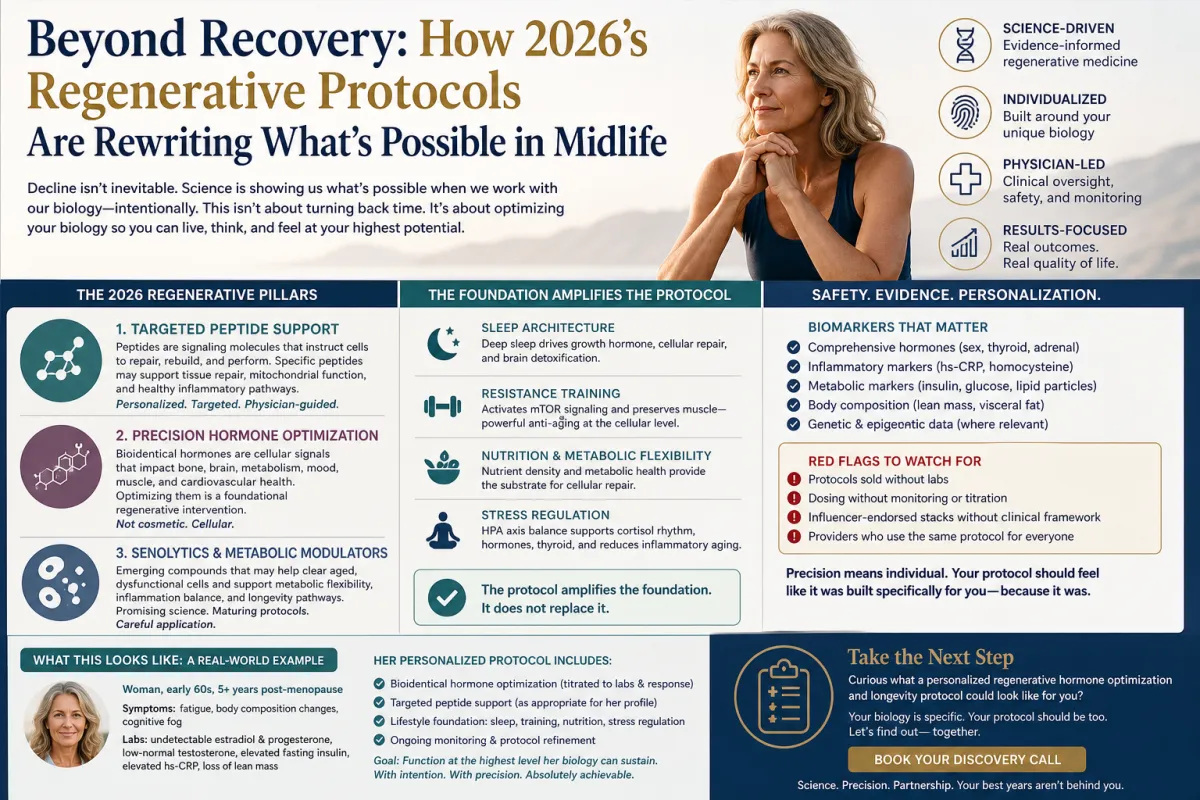
Beyond Recovery: How 2026's Regenerative Protocols Are Rewriting What's Possible in Midlife
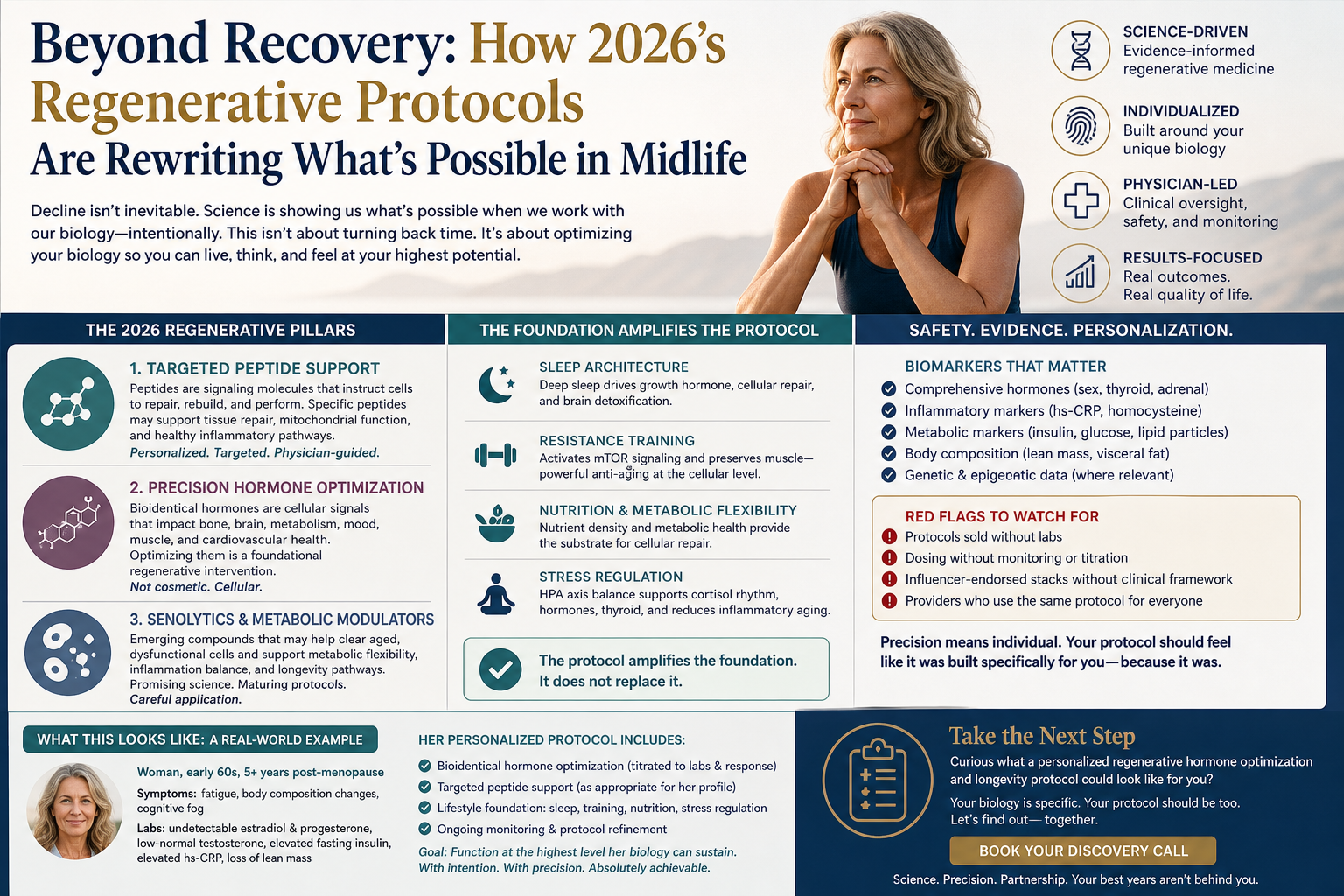
Beyond Recovery: How 2026's Regenerative Protocols Are Rewriting What's Possible in Midlife
Most people arrive at midlife with a quiet resignation — a sense that the fatigue, the shifting body composition, the mental fog, the diminished recovery are simply the price of getting older. They manage it. They adjust. They lower their expectations incrementally and call it wisdom. But something significant is happening in integrative medicine right now, and if you've been paying attention, you already sense it: the assumption that decline is inevitable is being challenged — not by wishful thinking, but by science.
The Shift Happening Right Now
What's changed is not one breakthrough — it's a convergence. Cellular biology research has accelerated to a point where we now understand the mechanisms of aging with a precision that simply didn't exist a decade ago. Advanced biomarker testing has become accessible enough to move from research settings into clinical practice. And personalized protocols — genuinely personalized, built around your individual biology — are replacing the generic 'eat well, sleep more, take a multivitamin' framework that was never really enough to begin with.
This is not biohacker culture. This is physician-level thinking applied to the question most of us are quietly asking:What is actually possible for me, at this stage of life, if I engage with my biology intentionally?The answer, increasingly, is more than most people realize.
What 'Regenerative' Actually Means in an Integrative Medicine Context
The word 'regenerative' has been captured by marketing, so let's be precise about what it actually means in a clinical context. Regenerative medicine, as practiced in evidence-informed integrative settings, is about supporting the body's own repair and renewal mechanisms — mitochondrial function, cellular senescence, tissue resilience, and the signaling pathways that govern how efficiently your cells maintain, repair, and renew themselves. It is not about injecting youth. It is not a luxury spa concept. It is about understanding where your biology's repair capacity is being compromised — and addressing those specific mechanisms with targeted, evidence-graded interventions.
The critical distinction is this: legitimate regenerative protocols are built on individual biomarker data and graded by evidence. The wellness industry is flooded with products and trends that borrow the language of regenerative medicine without the clinical framework underneath it. In practice, precision means individual — not algorithmic, not trend-driven, and never one-size.
The 2026 Landscape: Three Emerging Protocol Pillars Worth Knowing
Within integrative medicine, three protocol pillars are gaining serious clinical traction — and understanding them at even a conceptual level changes the conversation you can have with your physician.
Personalized Cellular Support via Targeted Peptides.Peptides are short-chain amino acid sequences that function as signaling molecules — they instruct cells and tissues to perform specific biological tasks. In regenerative contexts, classes of peptides are being studied and applied for their roles in tissue repair signaling, mitochondrial efficiency, and anti-inflammatory pathway modulation. This is an area where the clinical science is evolving rapidly, and where physician oversight is non-negotiable — the application must match your individual profile, not a generic protocol.
Precision Hormone Optimization as a Regenerative Foundation.This is the pillar most people underestimate. Bioidentical hormone optimization is not cosmetic — it is cellular. Estrogen, testosterone, and progesterone are directly tied to bone density maintenance, cognitive resilience, metabolic function, cardiovascular health, and the efficiency of cellular repair itself. When hormone levels decline in perimenopause, menopause, andropause, or earlier, the downstream effects accelerate virtually every marker of biological aging. Optimizing hormones with precision — using bioidentical compounds titrated to your labs, not population averages — is one of the most foundational regenerative interventions available.
Senolytics and Metabolic Modulators.Cellular senescence — the accumulation of aged, dysfunctional cells that secrete pro-inflammatory signals — is now understood to be a primary driver of systemic aging. Senolytic compounds, which research suggests may help clear these cells from tissue, represent one of the most exciting frontiers in longevity medicine. Similarly, GLP-1 adjacent metabolic tools are being studied for their applications beyond glycemic control, including metabolic flexibility and inflammatory modulation in a longevity context. The epistemic honesty required here: the early data is promising, the mechanisms are compelling, and the clinical protocols are still maturing. This is a space to watch, engage with carefully, and always evaluate with your physician.
Why Lifestyle Foundations Are Non-Negotiable (Not a Side Note)
I want to be direct about something, because it matters more than most people want to hear: regenerative protocols layered onto a poor lifestyle foundation produce diminished — and sometimes negligible — results. The protocol amplifies the foundation. It does not replace it.
Sleep quality, and specifically deep sleep architecture, is when growth hormone pulses, cellular repair occurs, and the brain clears metabolic waste via the glymphatic system. Resistance training activates mTOR signaling and drives muscle protein synthesis — two mechanisms that are directly anti-aging at the cellular level, and that no peptide or hormone alone can fully replicate. Nutrient density and metabolic flexibility determine whether your cells have the substrate they need to actually execute repair. And stress regulation — specifically HPA axis support — governs your cortisol rhythm, which in dysregulation will suppress sex hormones, impair thyroid function, and accelerate inflammatory aging regardless of what else you are doing.
These are not basic lifestyle tips. These are the biological inputs that cellular regeneration literally depends on. When I talk about lifestyle as a foundation, I mean it mechanistically — your protocol is only as powerful as the environment your cells are operating in.
Safety, Evidence Standards, and the Questions You Should Be Asking
The safety question deserves a direct answer: emerging regenerative protocols require physician oversight, proper baseline labs, and ongoing monitoring. Anything less is guesswork with your biology, and your biology deserves better than that.
The biomarkers that should anchor any serious regenerative protocol include comprehensive hormonal panels (sex hormones, thyroid, adrenal), inflammatory markers (hs-CRP, homocysteine), metabolic markers (fasting insulin, glucose, lipid particle analysis), and body composition assessment. Where relevant — and increasingly this is relevant — genetic and epigenetic data add meaningful precision to the picture.
The red flags are worth naming explicitly: protocols sold without labs, dosing without titration and monitoring, influencer-endorsed stacks with no clinical framework, and any provider who treats your protocol the same as everyone else's. Precision means individual. If your protocol doesn't feel like it was built specifically for you — because it was — then it probably wasn't.
What This Looks Like in Practice: A Real Protocol Framework
Let's make this concrete. Consider a woman in her early sixties, five years past her final menstrual period, presenting with progressive fatigue, significant body composition changes despite consistent effort, and cognitive fog that has quietly worsened over the past several years. On labs, she shows undetectable estradiol and progesterone, low-normal testosterone, elevated fasting insulin, elevated hs-CRP, and meaningful loss of lean mass. This is an extraordinarily common presentation in the postmenopausal decade — and it is not 'just aging.'
A correctly assembled regenerative protocol would begin with a full baseline assessment to understand her specific biological landscape. Hormonal optimization — bioidentical estradiol, progesterone, and likely testosterone — would be initiated and carefully titrated to her labs and symptom response, not population norms or arbitrary age cutoffs. In the postmenopausal context, this is not about mimicking a menstrual cycle; it is about restoring the tissue-level signaling her brain, cardiovascular system, bones, and skeletal muscle have been operating without. Targeted peptide support, where appropriate for her profile, might be layered in to support tissue repair signaling and mitochondrial efficiency. Her lifestyle anchors — sleep architecture, resistance training programming, nutrient strategy, and HPA axis support — would be assessed and reinforced as the essential foundation that amplifies everything built on top of it. And a structured monitoring cadence would be established, because this is not a set-and-forget prescription; it is a dynamic, evolving relationship with your biology.
The goal is not to feel thirty-five. The goal is to function at the highest level your biology can sustain — with intention, clinical precision, and the honest expectation that this is entirely achievable, even now.
The Mindset Shift That Makes All of This Work
Aging powerfully is not passive maintenance. It requires an active, informed relationship with your own biology — a willingness to move from managing decline to investing in cellular resilience. That identity shift is real, and it is the foundation of everything this community is built around.
The conversation that happens here — rigorous, honest, personalized, physician-led — is genuinely rare. Most people are navigating midlife with generic advice, outdated assumptions, and practitioners who don't have the time or training to go this deep. This community exists because that level of conversation is worth protecting and worth having consistently.
What aspect of regenerative medicine are you most curious — or skeptical — about right now? Drop it in the comments, and let's go deeper together.
Take the Next Step
Interested in learning what a personalized regenerative hormone optimization and longevity protocol could look like for you? Your biology is specific, your protocol should be too — and the starting point is a conversation built around your data, your goals, and your individual picture. Let's find out — together.


