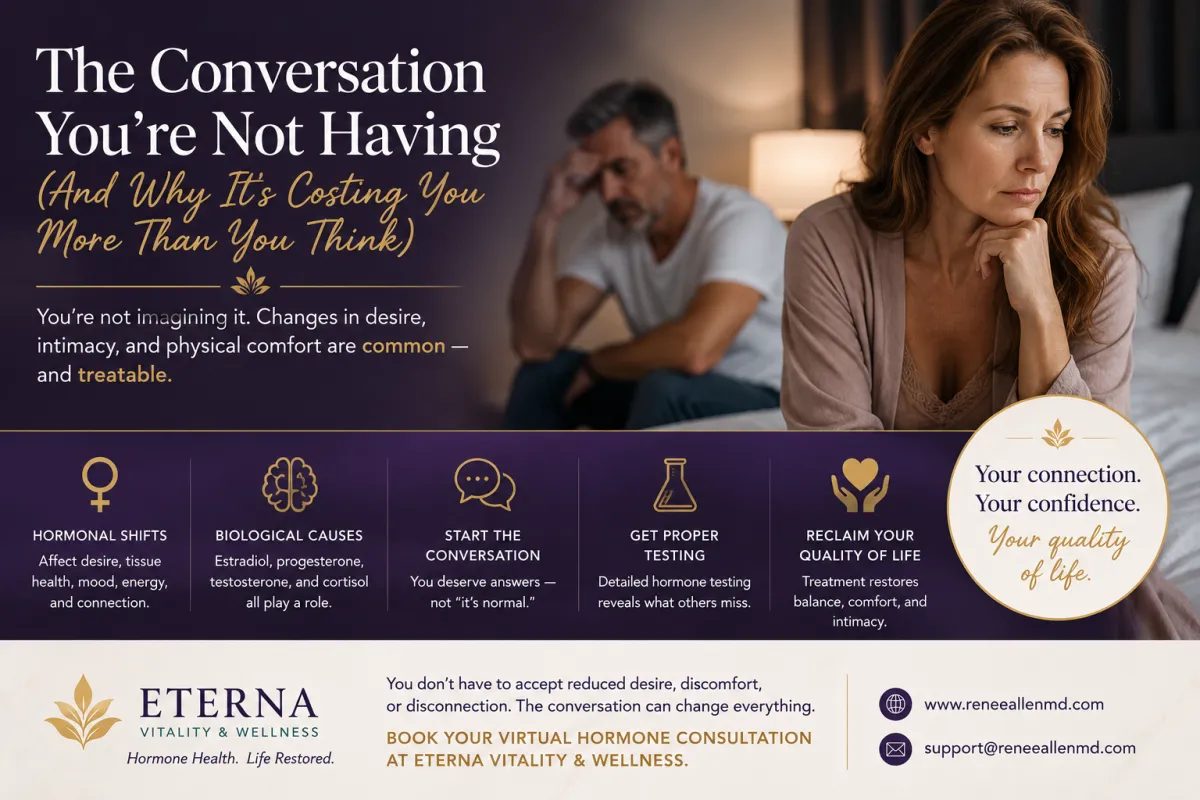
The Conversation You're Not Having (And Why It's Costing You More Than You Think)
The first time you noticed, you brushed it off. Maybe intimacy felt different — less comfortable, less natural. Maybe your interest disappeared without warning. Maybe you mentioned it to your physician and got told it was "normal for your age." So you stopped bringing it up.
But what you're experiencing has a name. It has a cause. And it responds to treatment.
You're Not Imagining It
Changes in desire, intimacy, and physical comfort are among the most common — and most undertreated — symptoms of hormonal transition. They affect both women and men.
What women commonly experience: reduced desire that feels like it came out of nowhere; discomfort or pain during intimacy; vaginal dryness or tissue changes; mood shifts that make connection feel harder; exhaustion that overrides interest in intimacy.
What men commonly experience: decreased interest in intimacy or difficulty initiating; reduced morning erections or erectile changes; lower confidence or motivation; fatigue that makes intimacy feel like work; mood changes including irritability and emotional distance.
These Symptoms Are Connected
They're all branches of the same root cause: hormonal shifts affecting energy production, brain signaling, tissue health, and stress response.
Estradiol supports vaginal tissue health, lubrication, elasticity, mood regulation, and sleep quality. When estradiol drops — during perimenopause, menopause, or postpartum — tissue thins, lubrication decreases, mood destabilizes, and energy crashes.
Progesterone supports calming brain signaling, sleep quality, and emotional resilience. Low progesterone shows up as irritability, insomnia, anxiety — all of which make intimacy feel harder.
Testosterone supports desire, libido, energy, and confidence in both women and men. When it drops, desire often disappears because the hormone driving interest is depleted.
Cortisol, when chronically elevated, suppresses sex hormone production. Your body literally shuts down desire when it thinks you're under sustained threat.
How to Start the Conversation
Instead of: "I just don't feel like myself anymore."
Try: "I've noticed changes in my energy, mood, and interest in intimacy over the past [timeframe]. Could this be hormonal?"
If experiencing physical discomfort: "Could tissue changes from low estradiol be causing this? What treatments are available for vaginal dryness or tissue thinning?"
What a Proper Evaluation Looks Like
At Eterna Vitality & Wellness, we assess estradiol, progesterone, testosterone (total and free), SHBG, FSH/LH, thyroid panel, and cortisol rhythm. "Normal" doesn't mean optimal. We look at where your levels fall, whether your symptoms correlate, and how your hormones are working together — or not.
You don't have to accept reduced desire, discomfort, or disconnection as something to just deal with. The hardest part is often starting the conversation. But once you do, you're no longer guessing.
Book your Ground Zero: First Step Consultation virtual hormone consultation at Eterna Vitality & Wellness.
www.reneeallenmd.com | [email protected]


