Why AI in Hormone Medicine Still Needs a Physician at the Helm
This week, I sat in on a working session for a clinical AI platform I'm actively helping to build. The technology was impressive — clean design, organized outputs, confident-looking hormone therapy reports generated in seconds.
And then I started reading the reports carefully.
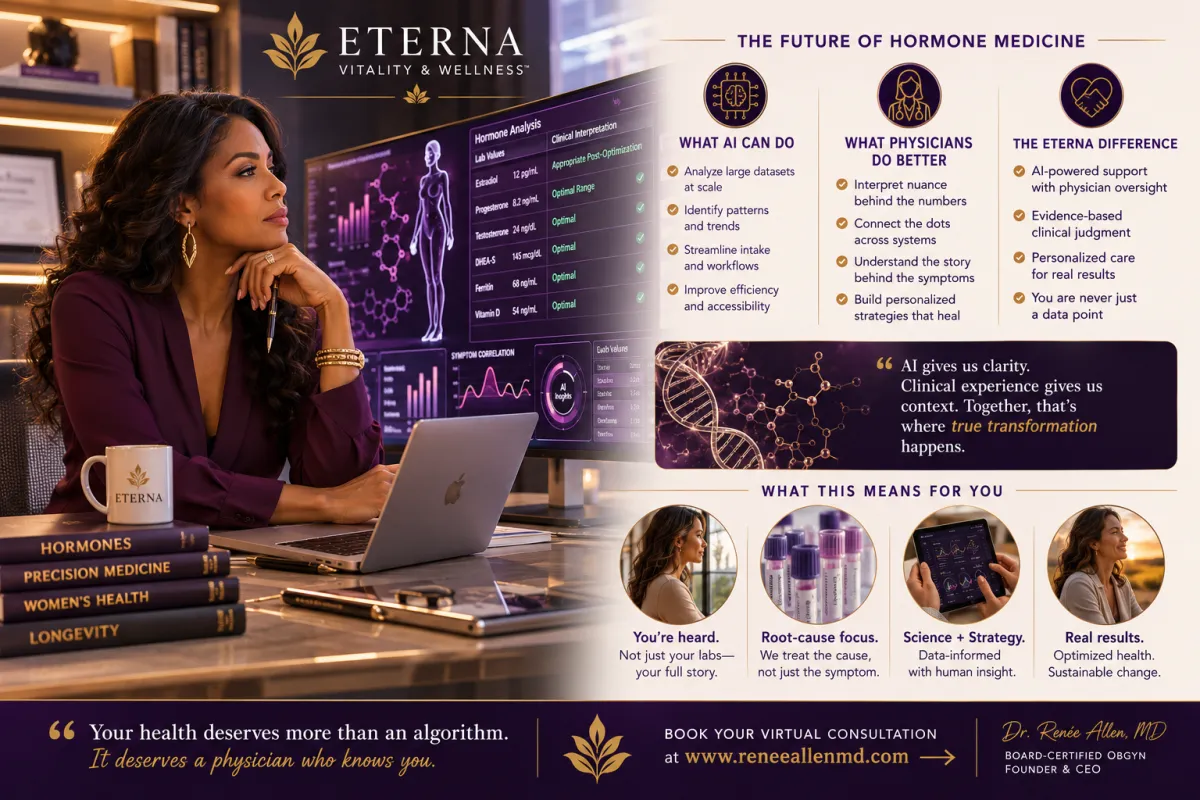
What I found stopped me: incorrect lab flag interpretations. Missing clinical connections. Estradiol values flagged as abnormal that were actually appropriate post-optimization. Symptom correlations a physician would catch in the first 90 seconds of a patient conversation — completely absent from the AI-generated output.
This wasn't a bad product. This was a well-built AI platform doing exactly what AI does: pattern-matching from data. The gap wasn't in the technology. It was in the irreplaceable layer that technology cannot replicate — clinical judgment built from decades of patient care.
The Promise of AI in Hormone Medicine
Let me be clear: I am not anti-AI. I am actively co-building AI-powered tools for hormone and metabolic medicine because I believe the technology has genuine transformative potential. AI can streamline intake questionnaires, flag trends across large datasets, reduce administrative burden, and support faster clinical decision-making. These are real, meaningful contributions to patient care.
In a field like bioidentical hormone restoration therapy (BHRT), where patient management involves tracking dozens of lab values, symptom clusters, medication adjustments, and lifestyle factors simultaneously, AI can give physicians back time. And time, in medicine, means better care.
But there is a critical distinction between AI as a tool and AI as a physician. That distinction matters enormously — and nowhere more than in hormone medicine.

What AI Cannot See
Hormone optimization is not a lab report. It is a conversation.
When a woman tells me she is "fine," and her estradiol is at 12 pg/mL, she is not fine. What AI sees is a number within a reference range. What I see is a woman who has learned to minimize her symptoms because no one took them seriously for years. I see the estradiol deficiency that explains her disrupted sleep, her rising cortisol, her brain fog, her joint pain — and the fact that she described all of these as "just stress."
AI cannot hear what is said between the lines. It cannot feel the pause before a patient says "I've just been a little tired." It cannot recognize that the anxiety a woman developed at 48 began the same month her periods became irregular — and that what she needs is not a referral to psychiatry, but an estradiol level and a physician who knows what to do with it.
These are not edge cases. These are the patients I see every week at Eterna Vitality & Wellness.
The Physician Remains the Architect
Declining estradiol does not just cause hot flashes. It affects bone density, cardiovascular health, cognitive function, skin integrity, metabolic rate, and the way a woman experiences her own life. Optimizing hormones for a 52-year-old woman in surgical menopause looks nothing like optimizing hormones for a 44-year-old in early perimenopause. Testosterone optimization for a man navigating andropause requires clinical nuance that no algorithm can fully account for.
This is why I believe the future of hormone medicine is not AI replacing physicians. It is AI giving physicians back the time to actually practice medicine — while the physician remains the architect of care, not an afterthought in a digital workflow.
What I saw in those AI-generated reports reminded me that the technology needs a physician at the center — not to rubber-stamp outputs, but to catch what the algorithm misses, to bring clinical intuition to data, and to ensure that every patient receives care that is truly personalized to them.
Building It Right
My work with clinical AI teams is specifically focused on this: ensuring that physician oversight is baked into the architecture from the beginning. That means AI-generated reports get physician review before they inform clinical decisions. That means intake questionnaires are designed to capture what clinicians actually need, not just what is easy to digitize. That means the physician's assessment — not the algorithm's output — drives the treatment plan.
I am doing this work because I believe it is possible to build AI that genuinely serves patients. But it requires physicians who are willing to be in the room, to push back, and to insist that clinical truth stays at the center of what we build.
What This Means for My Patients
If you are a patient at Eterna Vitality & Wellness, here is what I want you to know: I use technology to support your care, not to replace the relationship at the center of it. Every treatment plan I build is informed by your full picture — your labs, your symptoms, your history, and what you tell me in the quiet moments of our visits. No algorithm builds that for you.
You came here for a physician who listens. That is always what you will get.
If you are ready to take your hormonal health seriously — and to work with a physician who brings 20+ years of clinical experience to every decision — I would be honored to be your partner.
Book your virtual consultation at www.reneeallenmd.com.
Dr. Renée Allen is a board-certified OBGYN, physician executive, and Founder & CEO of Eterna Vitality & Wellness™ — a multi-state telemedicine practice specializing in bioidentical hormone restoration, metabolic optimization, and longevity medicine. She serves patients across 12 states virtually and is available for consultation at www.reneeallenmd.com.


