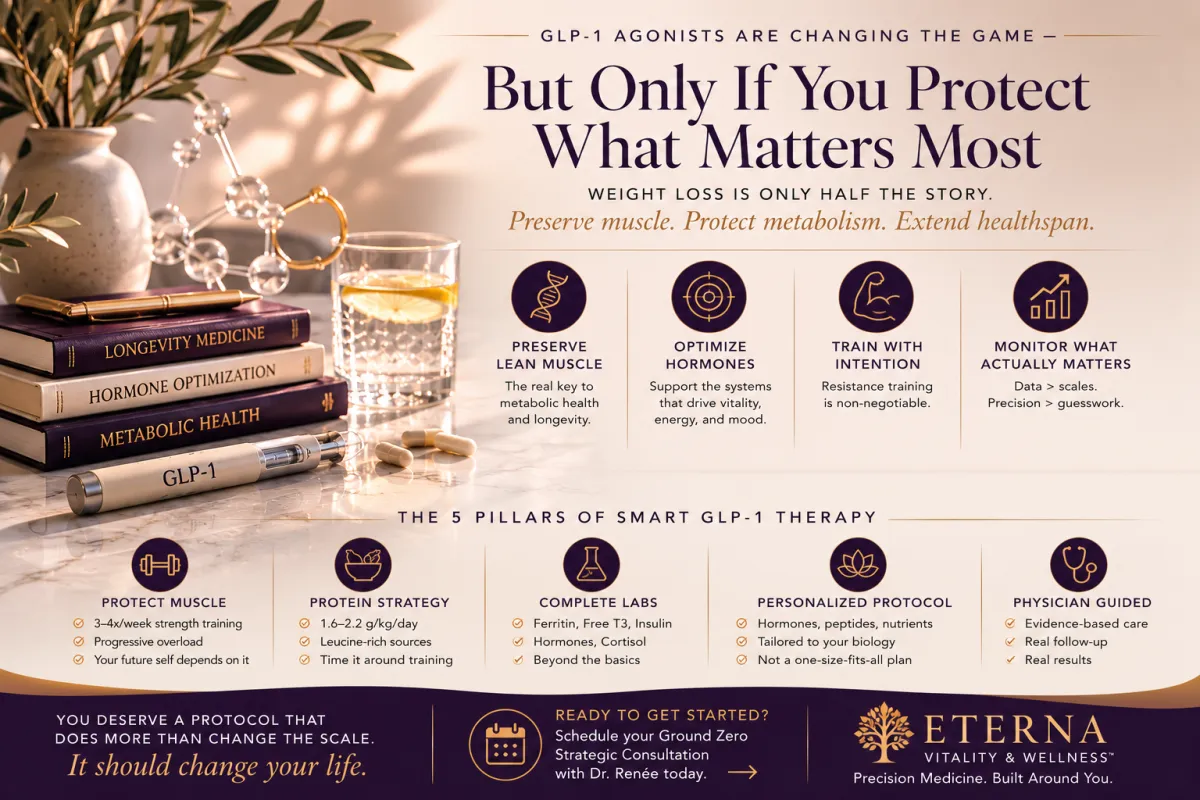
GLP-1 Agonists Are Changing the Game — But Only If You Protect What Matters Most
GLP-1 Agonists Are Changing the Game — But Only If You Protect What Matters Most
Something significant is shifting in how health-conscious midlife adults approach body composition and metabolic health — and if you've been paying attention, you already know what it is. GLP-1 agonists like semaglutide and tirzepatide have moved from diabetes management into the mainstream conversation around longevity and intentional aging, and for good reason. But there's a critical blind spot that almost nobody is talking about — and if you're using one of these therapies, or seriously considering it, this post may be the most important thing you read this year.
The Promise and the Blind Spot
The excitement around GLP-1 therapy is legitimate. These medications are producing meaningful metabolic results — improved insulin sensitivity, reduced visceral fat, better cardiovascular markers — and for a community like ours that refuses to leave vitality to chance, that kind of clinical evidence deserves serious attention. I'm not here to dismiss the promise. I'm here to name what the enthusiastic headlines are leaving out.
When weight comes off rapidly without a deliberate preservation protocol in place, a significant portion of what you lose is not fat — it's lean muscle mass. And in midlife, that is not a cosmetic issue. Muscle is the single most important tissue for your longevity, your metabolic rate, your hormonal environment, and your functional independence as you age. Losing it quietly, while the scale tells you a story you want to hear, is one of the most consequential mistakes you can make in a precision medicine context. The stakes here are lifespan and healthspan — and that's exactly why we need to talk about this clearly.
What GLP-1 Therapies Actually Do to Your Body Composition
GLP-1 agonists work primarily through appetite suppression, slowed gastric emptying, and improved insulin sensitivity. The result is a caloric deficit that most people sustain more comfortably than they could through willpower alone — and weight loss follows. But clinical studies reveal an uncomfortable truth:25 to 40 percent of total weight lost on GLP-1 therapy can come from lean mass, not fat.That number should stop you in your tracks.
Fat loss is desirable. Muscle loss is dangerous. These are not interchangeable outcomes, and the scale cannot tell you which one is happening. When you lose muscle, you reduce your resting metabolic rate — meaning your body burns fewer calories at rest, setting you up for rebound weight gain the moment therapy is discontinued. You increase your frailty risk. You disrupt the hormonal environment that keeps you feeling vital and capable. And you accelerate exactly the kind of passive decline that everyone in this community has made a decision to refuse. The weight going down is not the full story. It never was.
Resistance Training: The Non-Negotiable Foundation
I want to be direct about this:resistance training is not optional when you are using metabolic therapy.It is the primary protective mechanism available to you, and there is no supplement, peptide, or pharmaceutical that replaces it. The minimum effective dose is three to four sessions per week, built around compound movements — squats, deadlifts, presses, rows — with progressive overload applied consistently over time. That is the evidence-based standard, and it applies to you regardless of age, gender, or how busy your schedule is.
I hear the pushback, and I understand it. GLP-1 users frequently experience fatigue and reduced appetite, and training can feel harder, not easier, during this period. But that is precisely why structure matters more, not less. When motivation is low and energy is variable, having a non-negotiable training framework is what keeps the protective mechanism in place. There is also a powerful synergy worth knowing: resistance training independently improves insulin sensitivity — the same mechanism GLP-1 therapy targets. When you combine the two deliberately, you are compounding your metabolic benefit, not just maintaining it. That is what an optimized protocol looks like.
Protein Optimization: The Lever Most People Are Under-Using
Here is something that surprises people: your protein requirementsincreaseduring caloric restriction and metabolic therapy, not decrease. When you are eating less overall, your body's ability to preserve lean mass depends heavily on adequate amino acid availability. The evidence-based targets are1.6 to 2.2 grams of protein per kilogram of body weight daily, with an emphasis on leucine-rich sources — animal proteins, quality dairy, eggs — that directly stimulate muscle protein synthesis.
The practical challenge for GLP-1 users is real: when your appetite is suppressed, hitting those targets feels almost impossible. The strategies that work are straightforward but require intention. Prioritize protein at the beginning of every meal, before anything else. Time your protein intake around your training sessions. Use high-quality supplementation — a clean whey or collagen protein, for example — not as a shortcut, but as a tool when whole food intake falls short. And I want to be clear about one thing: these targets need to bepersonalized by a physicianbased on your kidney function, your metabolic labs, and your individual body composition data. Guessing at protein intake while on metabolic therapy is not a precision medicine approach — it's a gamble.
Monitoring That Actually Tells You What's Happening
Scale weight and BMI will mislead you on metabolic therapy. Full stop. They cannot distinguish between fat and muscle, and in the context of GLP-1 use, that distinction is everything. Precision monitoring means something different — it meansDEXA scanning or validated bioimpedanceto track lean mass directly, and it means comprehensive metabolic panels, fasting insulin, IGF-1, and full hormone panels covering testosterone, estrogen, and thyroid function, reviewed at regular intervals.
I think about this in terms of what I call themetabolic triad: muscle mass, bone density, and visceral fat. All three must be moving in the right direction simultaneously. If you are losing visceral fat but also losing muscle and bone density, you are not winning — you are trading one risk for another. Monitoring is not optional follow-up care. It is how a precision medicine approach protects you, catches problems before they compound, and gives your physician the data needed to adapt your protocol in real time. Without it, you are navigating without a map.
Where Regenerative and Hormonal Protocols Fit In
GLP-1 therapy in isolation is not a complete protocol. It is one powerful tool in a precision medicine toolkit — and for midlife men and women who are optimizing seriously, the integrative layer matters enormously. Optimized hormones — testosterone, estradiol, thyroid, DHEA, and when appropriate, growth hormone peptide support — are meaningful allies for muscle preservation during metabolic therapy. They work alongside your resistance training and protein strategy to maintain the anabolic environment your body needs to hold onto lean mass while losing fat.
Peptide protocols — including combinations like CJC-1295 with Ipamorelin or Tesamorelin for growth hormone support, or BPC-157 for recovery and tissue signaling — are adjuncts that can meaningfully support lean mass retention and metabolic function when applied appropriately. I raise these not to overwhelm you with options, but to make a critical point:none of this is something you piece together from a wellness blog.These are physician-prescribed, lab-guided protocols that require individualized decision-making. The promise of regenerative and hormonal medicine is real. The risk of applying it without proper oversight is equally real.
Aging Powerfully Means Asking Better Questions
The members of this community are already ahead — not because you have all the answers, but because you are asking the right questions. You are refusing passive decline. You are looking at evidence, engaging with complexity, and making informed decisions rather than drifting into whatever midlife hands you by default. That matters, and it positions you to benefit from therapies like GLP-1 agonists in a way that most people simply won't.
But the question to be asking is not simply'should I take this medication?'The question is:'If I use this therapy, what complete protocol ensures I come out stronger, leaner, and more metabolically resilient — not depleted?'That reframe is the difference between using a powerful tool wisely and using it recklessly.
For many people in this community, that complete protocol extends beyond GLP-1 agonists alone. Peptide protocols — including combinations like CJC-1295 with Ipamorelin or Tesamorelin for growth hormone support, or BPC-157 for recovery and tissue signaling — are adjuncts that can meaningfully complement a GLP-1 strategy when the goal is preserving lean mass, supporting repair, and sustaining metabolic resilience through the process. These are not shortcuts or additions for their own sake. They are precision tools, and like every tool in this space, their value depends entirely on how they are matched to your specific physiology, labs, and goals.
Precision medicine — physician-guided and evidence-informed — is what turns the right question into a real answer built for your body. More self-research will not get you there. A personalized conversation will.
Your Next Step: The Ground Zero Strategic Consultation
If this conversation has landed for you — if you are on GLP-1 therapy, considering it, or simply ready to take a more strategic approach to your metabolic and longevity health — the next step is not another article. It's a real conversation with a physician who can assess where you actually are and build a protocol around your specific biology.
I invite you to schedule a Ground Zero First Step Initial Strategic Consultation Session with Dr. Renée, Founder of Eterna Vitality & Wellness. In that session, you will receive a personalized assessment of your current metabolic picture, clarity on which therapies are appropriate for you, and a clear view of what a complete muscle-preservation and longevity protocol would look like — not in theory, but for your body and your goals specifically.
This is not generic wellness advice.
This is precision medicine, built around you.
What would it mean for your next decade if you got this right?


