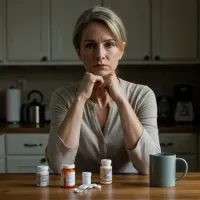
The Benadryl Menopause Hack Is Going Viral. Here's Why That's a Medical Failure, Not a Win.
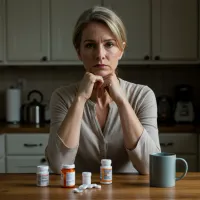
The Benadryl Menopause Hack Is Going Viral. Here's Why That's a Medical Failure, Not a Win.
When women reach for antihistamines to manage hot flashes, the healthcare system has already failed them.
—
A CNN investigation published this week documented something that should have made headlines years ago: women across the country are managing perimenopause and menopause symptoms — hot flashes, sleep disruption, mood changes, brain fog, digestive changes — with over-the-counter medications never designed for this purpose. Antihistamines for vasomotor symptoms. Antacids for GI changes. Diphenhydramine for sleep.
This is not resourcefulness. This is abandonment with a pharmacy receipt.
The Medical Failure Is Upstream
Before we discuss what antihistamines actually do — and do not do — for hormonal symptoms, we need to name what happened to create this situation. Women in perimenopause are routinely dismissed, undertreated, and sent home with prescriptions for antidepressants or referrals to therapists when the conversation should have started with hormone levels.
The average woman waits seven to ten years before receiving an accurate perimenopause assessment. Seven to ten years of symptoms that have real physiological underpinning — declining estradiol, shifting progesterone, testosterone fluctuation — being managed with Band-Aids because the physicians in the room were never adequately trained in hormone medicine.
The 2002 Women's Health Initiative study scared an entire generation of physicians away from prescribing hormone therapy. The fear was misapplied — the study enrolled women with an average age of 63, many over a decade past the protective window for hormone initiation — but the effect was lasting. Prescription rates dropped. Training stopped. Patients suffered.
So Yes, Antihistamines Sort of Work — And That's Exactly the Problem
Here is the clinical reality: histamine and estradiol share a bidirectional relationship. As estradiol declines in perimenopause, mast cell activity increases, contributing to histamine sensitivity and potentially worsening vasomotor symptoms. Blocking histamine receptors can modestly blunt some of this — which is why some women experience marginal relief from antihistamines.
But this is pharmacological duct tape. The underlying physiology is unchanged. The estradiol deficiency continues. The downstream risks accumulate.
Untreated menopause is not a quality-of-life inconvenience. It carries measurable, documented health consequences: accelerated bone density loss leading to osteoporosis, cardiovascular risk increase as estradiol-mediated vascular protection falls away, cognitive vulnerability (a 35% lower Alzheimer's risk is associated with timely hormone therapy initiation), and metabolic dysfunction that compounds year over year.
Women taking antihistamines for hot flashes are not protecting themselves from these risks. They are managing a symptom while the underlying process continues unchecked.
What Precision Hormone Medicine Actually Looks Like
At Eterna Vitality & Wellness, the first conversation is not about which supplement to add or which symptom to suppress. It is about what is actually happening inside your body — specifically, what your hormones are doing, where the deficiencies are, and what the evidence says about optimizing them safely within your individual risk profile.
For most women in early perimenopause, the data points clearly toward bioidentical estradiol and progesterone as foundational tools — started within the timing window (within ten years of menopause onset, or before age 60 for systemic therapy), monitored with lab work, and adjusted over time. This is not controversial. This is what The Menopause Society recommends, what the HHS labeling update confirmed in early 2026, and what the data has supported for years.
The timing window is real. The earlier the conversation starts, the more the data supports meaningful protection — for bone, for cardiovascular health, for brain health, for metabolic function. The women in the CNN report who spent years reaching for Benadryl were not in a stable holding pattern. They were losing time in a window that matters.
The Conversation You Deserve
If your physician's response to perimenopause symptoms was an antidepressant prescription, a referral to a therapist, or the phrase "this is just aging" — you have not received menopause care. You have received a referral away from the cause.
You deserve a physician who will order the right labs, read them in context, and build a protocol specific to your physiology, your history, and your long-term goals. Not a one-size-fits-all approach. Not under-dosed therapy that checks a box without moving the needle. A precision plan.
If you are in perimenopause or approaching it and the conversation has not happened yet, that is a gap worth closing now — not after years of antihistamines and symptom suppression.
→ Book a Precision Consult at reneeallenmd.com
Reverse Disease. Extend Healthspan. Optimize Vitality.
Your Health Isn't Random. It's Data. Strategy. Science.


